At a glance
A local GitHub repository inventory with source filtering, automatic categories, health scores, and optional commit and release history across discovered accounts.
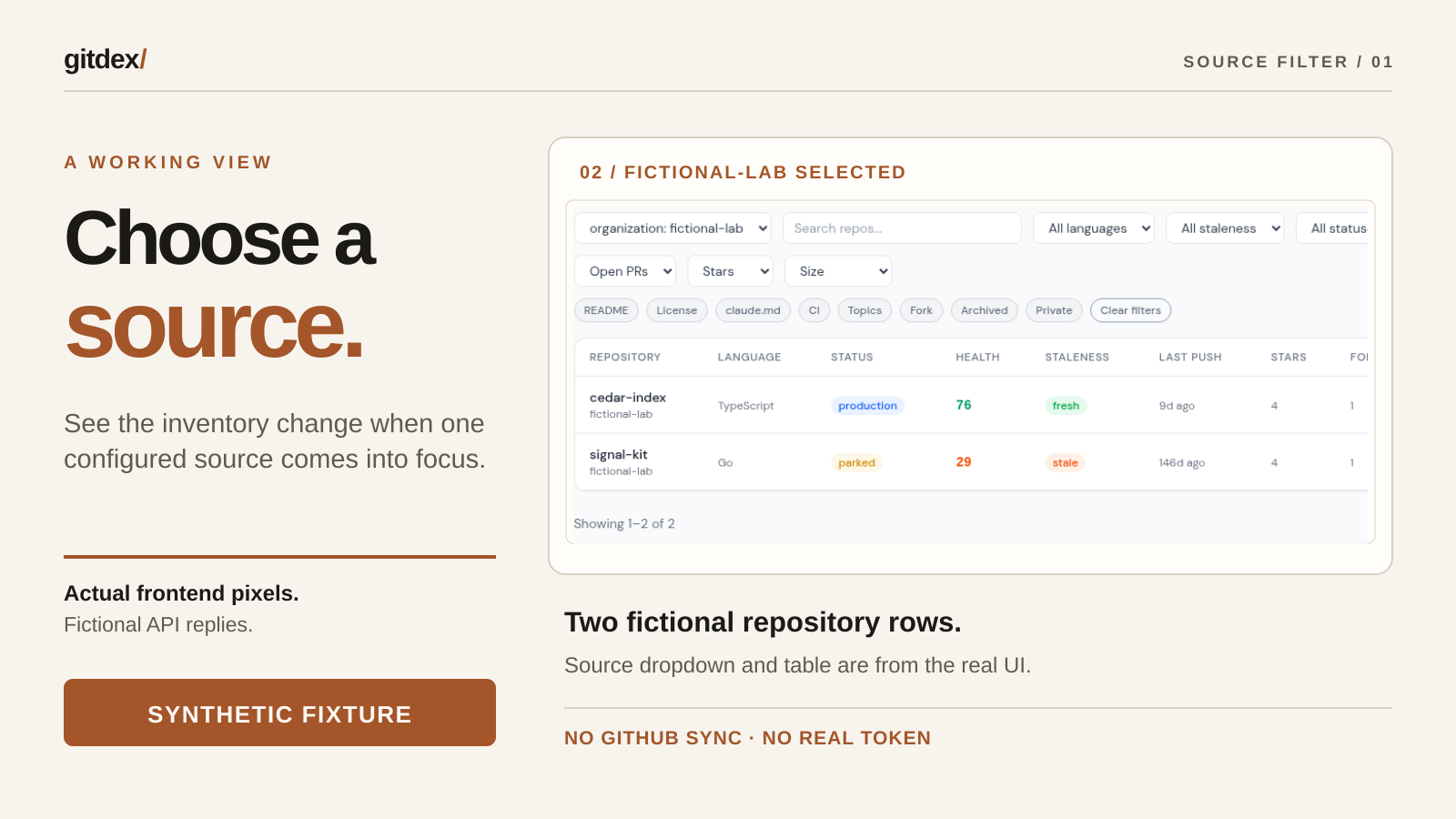
Vision
Once you cross a few dozen repositories, it becomes harder to see what needs attention. Gitdex gathers repositories visible to a supplied GitHub token from a discovered user and its organizations. The local inventory supports source filtering, categories, health scoring, and manual triage. Commit and release history requires optional deep analysis.
The Problem
Repositories accumulate across a personal account and organizations. Gitdex brings the sources the token can access into one local view, then adds configurable signals for triage. A source filter is not a guarantee of complete GitHub estate coverage; the result depends on token access, discovery and successful sync.
Key Differentiators
- Source view: browse all synchronized repositories or one discovered source account.
- Scored, not just listed: configurable health and staleness signals.
- Categorized automatically: names and topics provide categories; deep analysis can detect stacks.
- History on demand: deep analysis can collect commits and releases for a repository.
Current boundary
Gitdex runs locally from a restricted source checkout and does not provide a hosted account. The browser validates a GitHub token, stores it in local storage, and sends it to the local API as a bearer credential. The API uses that token for GitHub requests. Source selection in the inventory is available in current source; it has not been verified as a separately deployed public app. Repository identity across renames/transfers and incomplete metadata on sync failures remain product gaps.